The editor must be real before the AI is impressive
Selection, transforms, vectors, layout, components, undo and export are not legacy details. They are what turns generation into durable creative work.
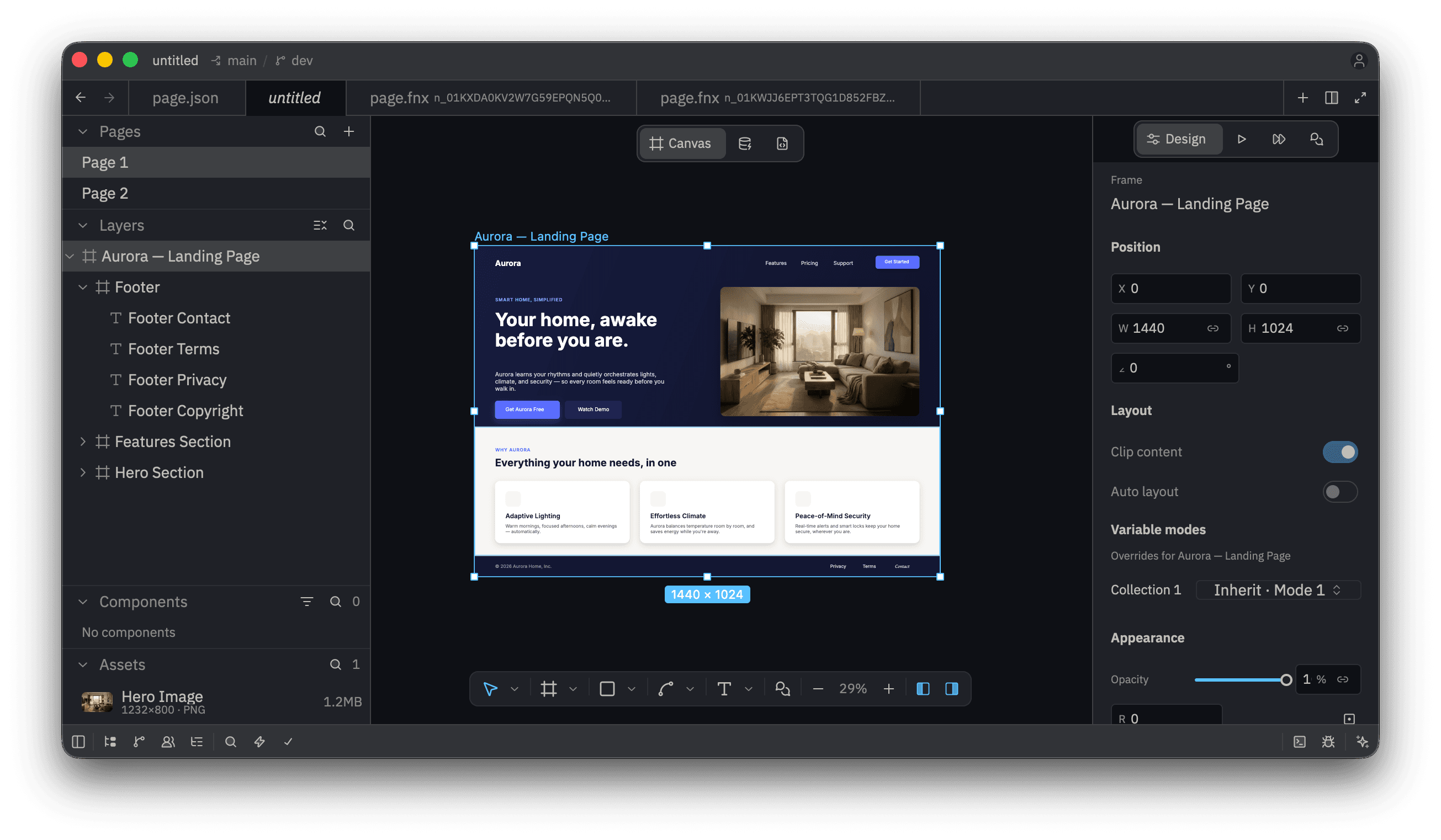
Fanta is an independent attempt to rebuild the design document for a world where humans, code and agents all need to edit it.
The premise
It still needs composition, hierarchy, masks, typography, reusable systems, responsive rules, feedback and versions.
Most AI tools stop before that work begins. Most design tools treat AI as an inserted image. Fanta starts from a different assumption: generation, precision editing and automation should operate on the same structured document.
Canvas
Editable
FNX
Readable
History
Visible
Operating principles
These principles decide what gets built, what stays local, and which shortcuts are rejected even when they would make a faster demo.
Selection, transforms, vectors, layout, components, undo and export are not legacy details. They are what turns generation into durable creative work.
FNX makes the document readable, diffable and useful to Git, code editors, build systems and agents without making the visual surface secondary.
Projects live on your disk. Cloud compute is something a project can call intentionally, not the only place the project is allowed to exist.
A useful design agent must understand nodes, layout, components, variables and history—and leave an operation a human can inspect and undo.
How it got here
Not a model wrapper that later discovered it needed an editor.
The observation
Creative work had become a relay race between prompts, exports, browser editors, model subscriptions and code handoff.
The document
Fanta started with a native canvas and an open, JSX-like FNX format so visual and source editing could share one model.
The convergence
Figma import, systems, prototypes, Git, agents, local smart tools and hosted generation grew around that same document.
The current chapter
The private alpha is putting the editor under real project pressure before platform expansion and collaboration.
100%
Native shell, no Electron
1
Document model underneath
3
Ways to run models: hosted, keys, private
Open
Source and roadmap in public
Independent and building in public
Fanta is founder-led, open-source and deliberately close to early users. The code, product decisions and rough edges are visible because trust grows from inspectable work.
Support is part of the alpha
Installation, credits, local files, privacy, model providers and editor workflows are covered in one practical support center.